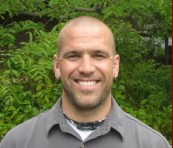
Many Hats, One Calling: Nate Kees
Published on Feb 4 2026Husband.
Father.
Colleague.
Head Athletics Trainer at College of the Redwoods.
These are just a few hats that Nate Kees gets to wear.
But let’s go back to 1990. When high-waisted gym shorts were introduced into the world of athletics. When fanny packs were worn as a fashion statement than necessity. When Leonard Taylor was the star forward on the basketball team, Brian Treggs led the team in receiving yards, and Sheila Hudson set lethal records for long jump and triple jump.
That’s where Nate Kees’s story begins, in the athletic training room at the University of California, Berkeley, where Nate’s mother was the Head Gymnastics Coach for seventeen years. And that’s where Nate grew up. Hanging out after school with some of the top collegiate athletes in the world. “It was the best place to go after school.”
Out of high school Nate was accepted to Oregon State University. His major? Pre-physical therapy. But what Nate soon realized was that he didn’t want to be a physical therapist. “They didn’t have the athletic training program they do now back then. I wasn't meant to not work on athletes.”
So, Nate made the decision to transfer from Oregon State to Humboldt State University (at the time). He finished out his soccer career and made the change to the athletic training program to become an athletic trainer (AT).
Fresh out of college, he took on his first athletic training position at Arcata High School, added summer seasons with the Humboldt Crabs starting in 2003, and worked simultaneously at Juvenile Hall for the Department of Corrections, demonstrating an early commitment to hard work and perseverance.
In 2010 he started working at College of the Redwoods under head athletic trainer at the time, Colby Higgenbothem, for the women’s side for two years before taking over full-time as the head trainer.
And Nate Kees hasn’t looked back.
As for a typical day in the athletic training room, Nate says, “There’s no off-season in athletics when it comes to my profession at the collegiate level. A typical day is chaos. During the fall semester, I can typically work 10-12 hours a day, sometimes 14 hours a day if travel is necessary. During the spring semester, it calms down to a standard eight hours a day, sometimes 10 hours with games, and if travel is necessary.” Nate goes on to say, “A typical day is filled with educating athletes on their bodies: running preps for practices, rehabilitation protocols, emergencies when they arise, and attending practices for oversight.”
It takes a special person to be an athletic trainer. “We are not only athletic trainers, but we are a dad, a mom, a brother, a sister, an uncle, and an aunt to some of these kids. We’re there to listen, to cry to, to vent to, to complain, to inquire,” Nate says. “And it’s our responsibility to keep them focused through an injury to help them with their identity as a student athlete. Good athletic trainers put their souls into their roles because it matters to them. Student-athletes’ success matters to them. Good relationships matter to them.”
Athletic help goes beyond the physical body. The support of student-athletes emotionally and mentally through recovery is equally important. “Mental and emotional maturity as a student-athlete, I feel, is paramount to their success. Without it, they can lose their way. We have to make them believe with our work (together) that they will get better. And we need them to trust us, that even though this process might suck at times, it is what is needed for the return. You must be the light for them, and it must be unwavering until they reach their goal.”
At times, an athletic trainer’s job can be relentless. Long days. Long nights. Injury after injury. Rehab after rehab. But there are also big gains. “We get to chase the dream with them. They are all here for a reason. Maybe they didn’t get into the college they wanted because they weren’t good enough. Maybe they need to develop (before moving on to the bigger stage). Bad grades. Missed opportunities. Poor support. No money. Whatever it is, they all dream of getting better and going somewhere. Next to that, watching them come back from an injury and play again, and knowing I had a part in that. And then next to that is the relationship I get to build with that student-athlete.”
In his spare time, Nate says, “Family first. But when they’re busy, training for Jiu-jitsu, downhill mountain biking and being somewhere outdoors without cell reception. But more times than not, I am with my family or assisting my wife (Amber) with the kids and their sports schedules.”
Nate’s favorite colors are reds, blues, greys, blacks, and anything camo!
When asked one thing people might not know about him, he says, “I paint my toenails black (like my soul). I have a purple belt in Jiu-jitsu, and my three boys are my biggest accomplishments (Tanner, Rylan, and Jaxon).
And because adjectives are important to stories, here are a few words/phrases that his colleagues used to describe him:
“Humble.”
“Strategic. He always has a plan for the sport, and specifically when it comes to the rehab process of a student-athlete.”
“Authentic. Always true to who he is and doing what is right for both the student-athlete and the programs.”
“Reliable.”
“Devastatingly honest.”
“Colossal talent, and we’re so lucky to have him.”
At the end of the day, when the sun has set behind College of the Redwoods, the buildings stand, emptied of their fill, you’ll find Nate, sweeping the training room, putting things in their rightful place, pulling in water from the gym after evening practices, and carrying with him a quiet commitment for a new day as he heads home on the 101.
Because that’s who Nate Kees is….
Husband.
Father.
Colleague.
Athletic Trainer.
A human making a big impact on this world, one student-athlete at a time.